Humanoid robots have moved beyond the development lab. The first systems are transporting totes in distribution centers, supplying workstations with materials, and performing physically demanding tasks in production environments. At the same time, high-profile demonstrations can easily create a distorted impression of how far the technology has actually progressed in industrial applications. Logistics leaders therefore need a realistic assessment. The decisive factor is not which movements a robot can perform under controlled conditions. What matters is whether it can reliably handle a specific task within an existing material flow while offering an advantage over established automation solutions.
This article is the first in a three-part series on humanoid robots in logistics. It examines which applications are already realistic and where the technology still reaches its limits. The second article will explore the conditions a logistics facility must meet before deploying its first humanoid robot. The third will focus on the path from pilot project to productive operation.
The Difference Between a Demonstration and Logistics Performance
Public perceptions of humanoid robotics are heavily influenced by individual capabilities. Robots walk across uneven surfaces, pick up different objects, or respond to spoken instructions. These demonstrations illustrate how quickly mechanics and AI are advancing. However, they reveal relatively little about a system’s suitability for industrial use.
Day-to-day operations are measured by different standards. A task must succeed not once, but consistently across many repetitions. The required cycle time must align with adjacent processes. Deviations must not cause repeated interruptions, and there must be a clearly defined response to disruptions. This is where technological feasibility and operational value begin to diverge. A robot may be capable of picking up a tote in principle. Whether this results in a viable logistics process depends on how reliably it recognizes the tote, how consistently it grips it, and how the system responds when the tote is not in the expected position.
From a consulting perspective, any assessment of humanoid robotics should therefore begin with the process. A technical capability alone does not constitute a suitable use case.
Why the Humanoid Form Factor Matters
Many existing logistics facilities have evolved over many years. Workstations, walkways, and transfer points were designed for people. Automation added later often covers only specific sections of a process. Interfaces remain between conveyor systems, manual work areas, and mobile robots, with employees continuing to manage the handoffs between them. Conventional automation can close these gaps, but it often requires fixed equipment or changes to the operating environment. Conveyor lines may need to be extended, transfer stations modified, or additional robotic cells installed. This can make economic sense when volumes are high and stable. When requirements change frequently or volumes are relatively low, however, the necessary investment may exceed the expected benefit.
This is where the real potential of humanoid systems lies. Their design allows them to operate in existing work areas, reach different heights, and pick up objects independently. As a result, not every process has to be adapted to accommodate permanently installed equipment. Their physical resemblance to humans is less important than the combination of mobility and object-handling capabilities. This combination could help automate tasks that currently fall between existing technical solutions.
Which Applications Are Realistic Today
The first industrial use cases are focusing on clearly defined, frequently repeated tasks. Processes involving standardized totes or components with a limited number of potential deviations are particularly suitable.
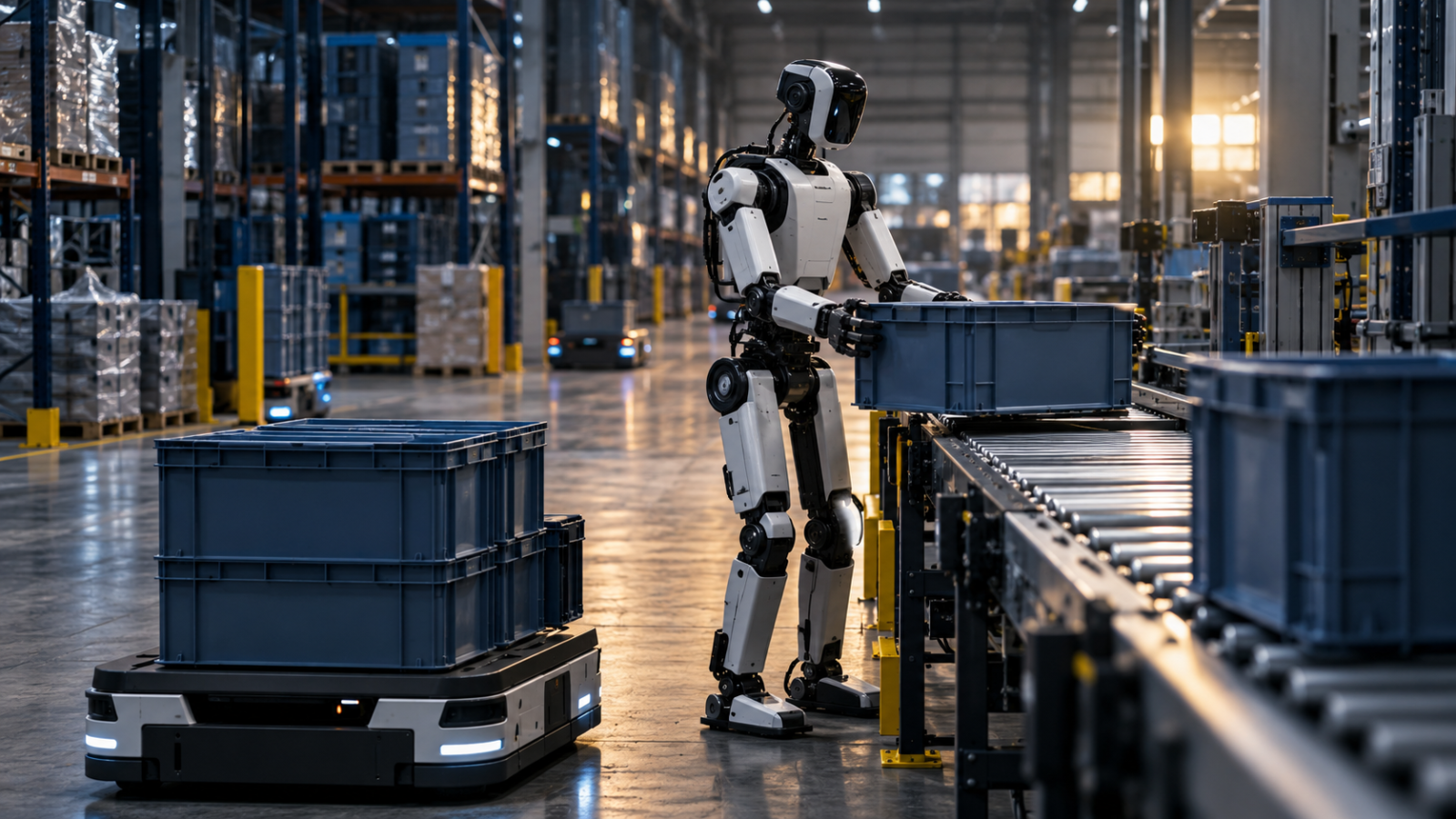
In logistics centers, for example, humanoid robots can transfer totes from mobile transport systems to conveyor equipment. In production environments, they are being tested for material supply and for loading defined components into machines or workstations. Serving several transfer points within a limited area may also represent a viable use case. What these tasks have in common is that they do not require a universal problem-solving capability. The robot moves known objects between defined points and operates within a prepared workflow. The process can be monitored, and its performance can be assessed using specific metrics. These relatively unspectacular applications are especially important for the technology’s continued development. They show whether a system can operate reliably over extended periods and reveal the level of support, disruption management, and integration required.
The most realistic starting point is therefore not the complete takeover of a complex workstation. Individual process steps are more promising, particularly when they are repetitive or physically demanding and cannot be automated economically using existing solutions.
Why Versatility Remains a Promise for Now
One of the main arguments in favor of humanoid robots is their potential versatility. In the future, the same system could perform different tasks and be reassigned when requirements change. This fundamentally distinguishes the concept from equipment whose mechanics are permanently designed for one specific operation.
For current projects, however, this potential must be assessed realistically. Even a robot designed for flexibility initially requires a clearly defined task. Objects and transfer positions must be known. Motion sequences have to be adapted to the specific process, and clearly defined responses are required for exceptions. The technical platform may be suitable for several applications, but this does not mean the robot can switch between any number of tasks without additional effort.
Each new task requires its own assessment and must be tested under real-world conditions. The initial business case must therefore be based on a specific process. Using the robot for multiple tasks at a later stage may improve the economics, but this should not be treated as a guaranteed benefit during the first evaluation.
Where Conventional Automation Remains Superior
Humanoid robotics expands the range of available automation options, but it does not replace established technologies. Conveyor systems will generally remain more capable in applications with high throughput and consistent material flows. A stationary robotic arm will usually achieve shorter cycle times and greater accuracy when performing repetitive movements. For transport-only tasks, autonomous mobile robots or automated guided vehicles are often easier to integrate.
A human-centered working environment alone is also not enough to justify using a humanoid system. If a task can be eliminated through a manageable process change or handled more easily with proven technology, there is little reason to deploy a more complex system. Consulting projects therefore require a technology-neutral comparison. The evaluation must consider more than the purchase price or ongoing operating costs. Achievable performance, space requirements, and integration effort are equally important, along with any potential restrictions on day-to-day operations.
The central question is not: Where can a humanoid robot be deployed? It is: Which solution will meet the specific process requirements most reliably and economically over the long term?
The Greatest Potential Lies at Process Boundaries
Humanoid robots become particularly interesting where existing automation ends at a manual interface. Such transitions often exist because two systems were implemented during different project phases or because a fixed technical connection has not been economically viable.
Employees may transfer individual totes, provide materials at another station, or compensate for different transfer heights. Each of these tasks may appear manageable in isolation. Over the course of a shift, however, they still require labor and can slow down adjacent processes. A humanoid robot could serve as a mobile link at these interfaces. Unlike fixed equipment, it would not be permanently tied to a single transfer point. At the same time, it could perform tasks that a transport-only vehicle cannot handle because objects must be actively picked up and set down.
Whether this creates an economic advantage depends heavily on the individual facility. The more frequently tasks change, and the more extensive the modifications required for conventional technology would be, the more valuable this additional flexibility may become. With stable volumes and consistently structured processes, however, the argument becomes less compelling.
Where the Technology Still Reaches Its Limits
The maturity of humanoid systems varies considerably. Payload capacity, battery life, and achievable speed differ from one provider to another. Another important question is how reliably a system can handle different objects and unexpected situations.
Exceptions within the process are particularly challenging. Totes are not always positioned exactly where expected. Travel paths may be temporarily blocked, and load carriers may be damaged. A person will generally recognize such situations immediately and adjust their actions accordingly. A robot must first identify the deviation correctly before it can respond appropriately. Safety also remains a limiting factor. Many current applications begin in defined work areas where contact with people is restricted or separated by time. This enables a controlled introduction but also reduces the flexibility associated with the humanoid form factor.
These limitations do not rule out productive use. They do, however, determine which processes are currently suitable. The less structured the environment and the greater the number of potential deviations, the more safeguards and operational support will be required.
Conclusion: An Additional Option for Processes That Are Difficult to Automate
Humanoid robots are not a universal solution for manual logistics processes. Their realistic application area currently consists of clearly defined tasks in which they move standardized objects or manage transfers between existing process areas. Their particular advantage emerges where conventional automation would require extensive modifications and transport-only solutions are insufficient. In the future, humanoid robots could therefore close a gap between manual labor and specialized automation.
Whether this advantage is viable at a specific facility cannot be determined from a product demonstration. Process requirements and possible alternatives must be evaluated together. Only this assessment can show whether humanoid robotics can make a reliable operational contribution or remains merely an interesting technical option.
The Next Step: Evaluate the Potential Without Favoring a Specific Technology
Many companies are monitoring the development of humanoid robots but cannot yet reliably assess their relevance to their own logistics operations. A structured analysis of existing processes can provide clarity. It identifies where manual transfers or physically demanding tasks occur and determines which automation option is best suited to each application.
If you would like to assess whether humanoid robotics is already relevant to your logistics operations and identify which processes warrant closer examination, talk to us. EPG Consulting can help you evaluate automation opportunities independently of specific manufacturers and place humanoid robotics within the broader context of your logistics strategy.
In the next article in this series, we will examine the process, infrastructure, and organizational requirements a logistics facility must meet before it is ready for an initial humanoid robot deployment.